Island in the Sky Visitor Center
38.4599, -109.8210 · Park boundary: National Park Service
Take the scenic way to Island in the Sky Visitor Center.
Byway plans around your taste, verified places, real weather and opening hours — then opens every leg in Google Maps with one tap.
The Island in the Sky Visitor Center offers exhibits, book & map sales, park orientation film, backcountry permits, general information, vault toilets, and park rangers on duty. You can get drinking water inside (during open hours) or outside (24 hours a day) during summer and fall. Water is only available inside (during open hours) in winter.
- Every day
- 8:00AM - 5:00PM
The Island in the Sky visitor center is normally open daily year-round with reduced hours in late fall, winter, and early spring. It closes early on Thanksgiving and Christmas Eve and is closed for Christmas Day (December 25). Hours vary with the season.
- Early Spring Hours · Mar 15, 2027 – Apr 4, 2027 · Every day 8:00AM - 4:00PM
- Late Fall Hours · Oct 24, 2026 – Nov 28, 2026 · Every day 8:00AM - 4:00PM
- Thanksgiving Hours · Nov 26, 2026 – Nov 26, 2026 · Thu 9:00AM - 1:00PM
- Winter Hours · Nov 29, 2026 – Mar 13, 2027 · Every day 9:00AM - 4:00PM
- Christmas Eve/Christmas Day · Dec 24, 2026 – Dec 25, 2026 · Mon–Wed 9:00AM - 4:00PM, Thu 9:00AM - 1:00PM, Fri Closed, Sat–Sun 9:00AM - 4:00PM
Canyonlands Passport Cancellation, Island District, UT.
On US 191, drive 10 miles north of Moab or 22 miles south of Interstate 70 (Crescent Junction), then take UT 313 southwest for 22 miles. Follow signs for Canyonlands National Park. Drive time from Moab is roughly 40 minutes to the visitor center.
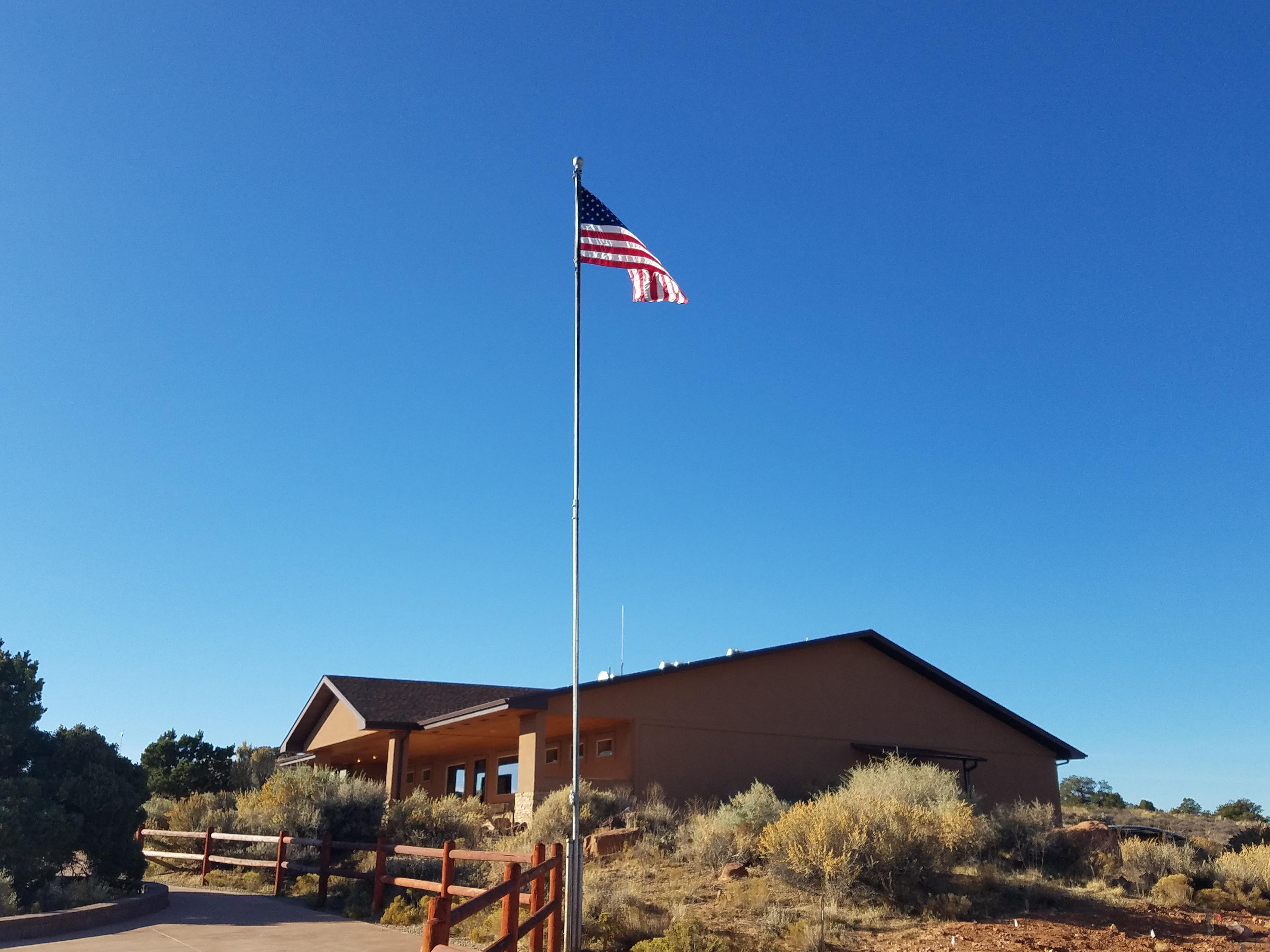
The Island in the Sky Visitor Center is a low-profile building with scenic vistas. To its north, a flat grassland extends to low lying cliffs and a towering mound of sandstone dominates the horizon. Looking west from this sandstone butte, the mix of grassland and low lying cliffs extends for miles until reaching the San Rafael Swell, a range of sandstone abutments. Directly behind the visitor center to its west and south, a small hill dotted with short Utah juniper and pinyon pine trees buts against the building. Across from the visitor center, to the east, the landscape drops away dramatically into a canyon two thousand feet deep. The canyon is wide enough to fit towering buttes and ever deepening canyons, yet the river that carved it is not visible. Every rock within the canyon is a deep, earthy red. Beyond the canyon rim in the distance, the La Sal Mountains ascend to over twelve thousand feet above sea level, twice as high as you now are. The building is situated to the west of a north-south roadway with a large parking lot in between the two. Directly north of the building is a line of pit toilets next to a flag pole, and beyond that four picnic tables, covered by wooden shade structures, extend into the grassland. Extending directly from the building’s front doors is a red concrete pathway, to either side of this, a mass of blue-grey desert shrubbery blocks much of the view of the visitor center from the road. The front of the building is dominated by a covered patio. Benches line the walls below a couple of large windows. North of the front doors, the patio is bare, left open as a space for educational programs. To the south, a couple of billboards provide basic information about the park and the patio extends beyond and around the building to a water spigot and another set of covered picnic tables. Inside the visitor center, a scale model of the canyons outside and further into the park sits near the front doors, slightly to the right. Signs surrounding this model briefly describe the different districts of this large park. Beyond this, a gift shop takes up the northern half of the visitor center’s interior. Columnar shelves are scattered about the floor while the northmost wall is covered in bookshelves and shirts for sale. A small dividing wall with a glass representation of an arch extends into the gift shop’s space. Upon this small dividing wall if a water fountain. The wall opposite the front doors, the western wall, is lined by a row of desks covered in maps and information used by the rangers behind to help plan trips to the park. The southern half of the visitor center’s hall holds an informational exhibit space, detailing the geology, history and ecology of the park. A doorway on the western wall of this space leads into a theater, where rows of benches sit in front of a big screen tv that shows the park film. White walls and dark brown floors define the sides of this large but full space.
Location, hours, and facility details confirmed against the National Park Service registry.
National Park Service registryChecked 2026-08-04
Where is Island in the Sky Visitor Center?
Island in the Sky Visitor Center in Canyonlands National Park is at Off UT 313, approximately 22 miles southwest US 191, Moab, UT.
What services does Island in the Sky Visitor Center offer?
Island in the Sky Visitor Center in Canyonlands National Park lists benches/seating, bicycle - rack, gifts/souvenirs/books, information - ranger/staff member present, permits issued, picnic table, telephone, theater/auditorium, toilet - vault/composting, trash/litter receptacles, water - bottle-filling station, wheelchair accessible.
Is there a passport stamp at Island in the Sky Visitor Center?
Yes. Island in the Sky Visitor Center in Canyonlands National Park is a National Park Passport stamp location. Canyonlands Passport Cancellation, Island District, UT.
What is the phone number for Island in the Sky Visitor Center?
Island in the Sky Visitor Center in Canyonlands National Park can be reached on 435-241-1314.
Drive to Island in the Sky Visitor Center
Byway plans the scenic way in — real places, real weather, every stop verified. Zero hallucinations. Google Maps for turns. Byway for soul.